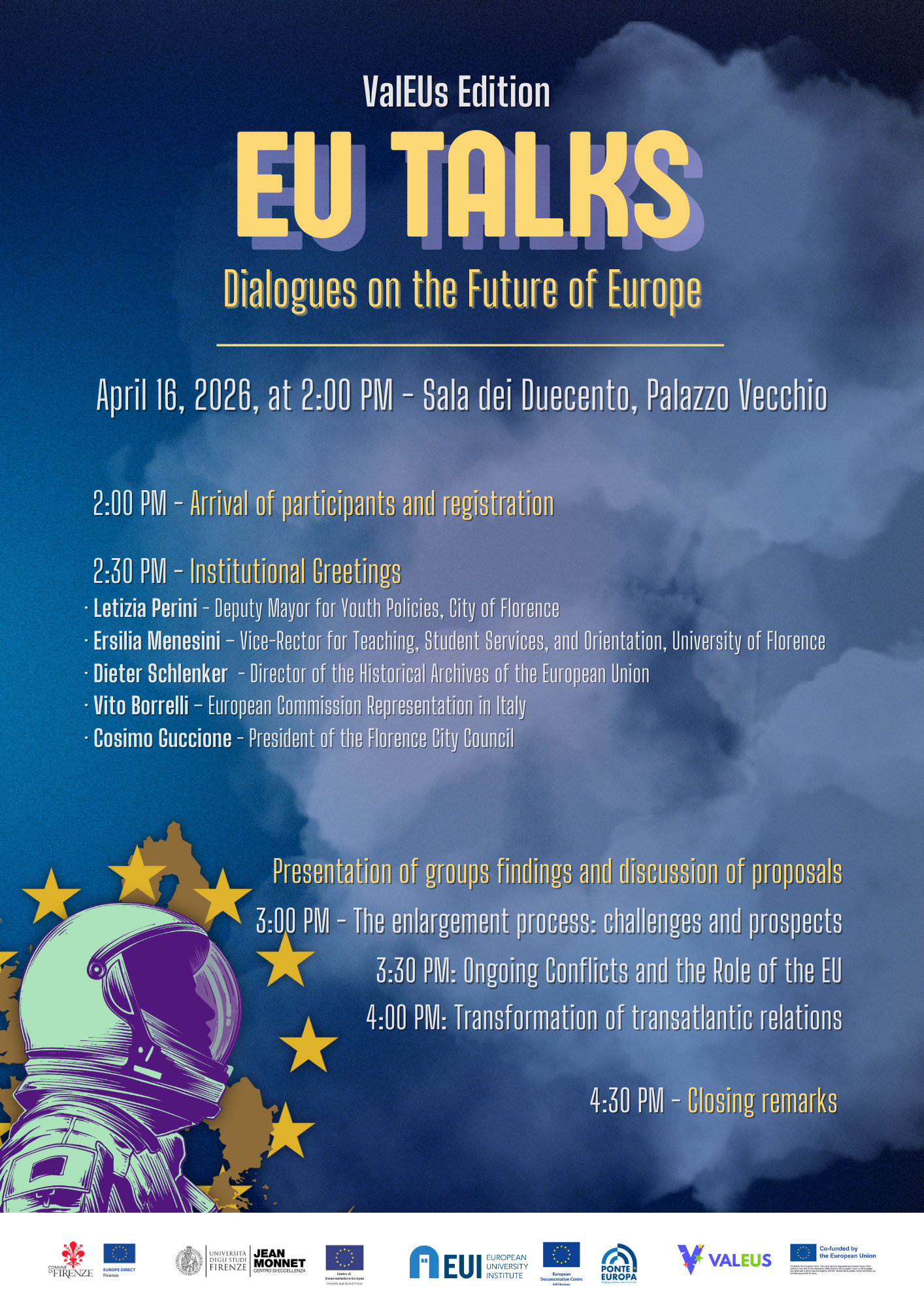
EU Talks 2026: Students Discuss the Future of Europe in Florence

The event is free of charge. Participants who would like to attend in person are kindly asked to register in advance for organisational reasons.

For those who cannot join in Florence, the event will also be livestreamed on the official YouTube channel of the Municipality of Florence.

Watch the livestream here:

Register for in-person participation here:

Next week, the sixth edition of EU Talks – Dialogues on the Future of Europe will bring together students from partner universities across Europe and beyond in Florence.

EU Talks is an initiative dedicated to students, offering a platform to discuss key issues concerning the European Union and its global role. 

The initiative was organised in two phases. Between January and March 2026, students participated in a series of online roundtables and discussions coordinated by researchers and experts. During these meetings, participants worked in thematic groups and exchanged ideas with students and researchers from different European universities.

The second phase will take place in Florence from 13 to 17 April 2026 as part of the International Week of the School of Political Sciences. During this week, participants will meet in person to continue their discussions and present their reflections.

The initiative will conclude with a final public event on 16 April 2026 in the Sala dei Duecento at Palazzo Vecchio, which will also be livestreamed on the official YouTube channel of the Municipality of Florence.

During the event, the three student groups will present the results of their work and discuss their proposals with institutional representatives.

The programme includes:

  • 3:00 PM – The Enlargement Process: Challenges and Prospects
  • 3:30 PM – Ongoing Conflicts and the Role of the EU
  • 4:00 PM – The Transformation of Transatlantic Relations

Date & time: 16 April 2026 | 2:00-4:30 PM CET

Venue: Sala dei Duecento, Palazzo Vecchio, Florence

Live stream: via YouTube

This ValEUs initiative is organised in cooperation with EUROPE DIRECT Firenze, the European Documentation Centre and the Jean Monnet Centre of Excellence at the University of Florence, the European Documentation Centre of the European University Institute, and Ponte Europa

Funded by the European Union. Views and opinions expressed are however those of the author(s) only and do not necessarily reflect those of the European Union or the European Education and Culture Executive Agency (EACEA). Neither the European Union nor EACEA can be held responsible for them.