

Young Generation Policy Brief no.8: Ukraine’s EU accession process

Welcome to our Young Generation Policy Briefs series!
In this eighth issue, Matthias Vollmer examines the political dynamics surrounding Ukraine’s EU accession process, focusing on the challenges that threaten the credibility of the negotiations.

Explore all Young Generation Policy Briefs here!

The EU could lose credibility in the accession process with Ukraine, as Hungarian Prime Minister Viktor Orbán is threatening to repeatedly veto the opening of chapter negotiations. This means that the EU cannot guarantee that accession will take place, even if Ukraine fulfills all the reform requirements.

This brief assesses three options that could solve the credibility problem:

(1) Withdrawing Hungary’s voting rights

(2) Reforming the unanimity principle and

(3) Making systematic use of the chapter structure to intertwine Hungary’s cultural and economic interests with Ukraine. The third option is the most suitable, as it would increase Viktor Orbán’s interest in Ukraine’s accession and ensure predictable progress in the negotiations for Ukraine.

Young Generation Policy Brief no. 8:

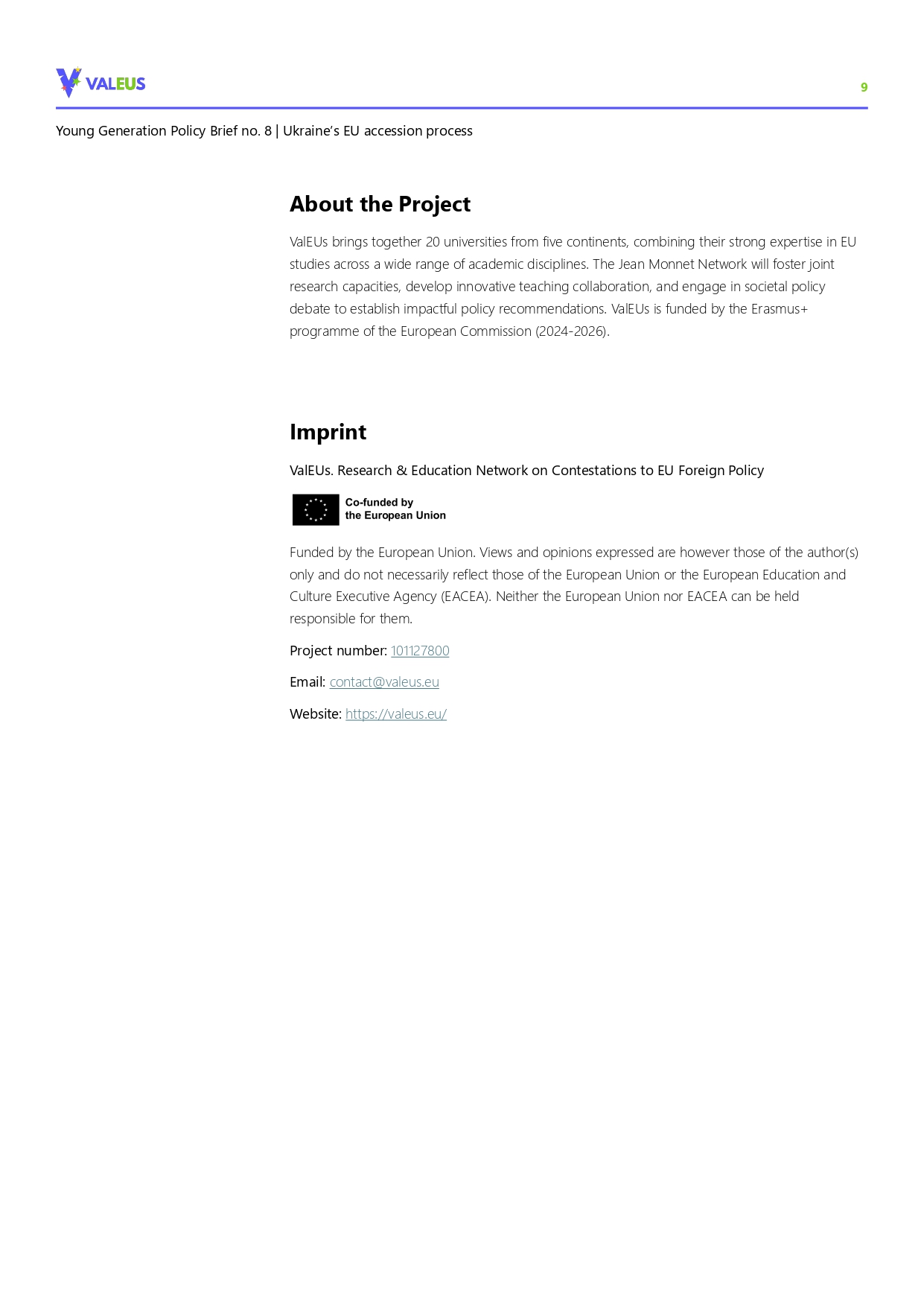
About the author:

Matthias Vollmer

MA Student in European Studies, European University Viadrina

Matthias Vollmer is a master’s student in European Studies at the European University Viadrina. Having grown up bilingual, his academic interests lie in cross-border issues at the intersection of economics, politics, and law. During his bachelor’s degree in business administration at the Free University Berlin, he focused on corporate governance, social responsibility, and law. In addition to his studies, he has already gained work experience in the fields of anti-corruption, data protection, and environmental, social, and governance issues, and works as a student assistant at a law firm.
ValEUs Young Generation Policy Briefs

Policy briefs are regularly published as part of the Jean Monnet Policy Network “ValEUs”. The project, which is intended to provide a realistic account of EU foreign policy, thus aims to expand the societal dialogue on project results. The policy briefs are written from a student perspective, identifying problems with the self-proclaimed European values and suggesting possible solutions. 

Funded by the European Union. Views and opinions expressed are however those of the author(s) only and do not necessarily reflect those of the European Union or the European Education and Culture Executive Agency (EACEA). Neither the European Union nor EACEA can be held responsible for them.